 When people come to Nepal, mostly with a trekking experience to share with friends and family back home, and so it is the case for us. From the first time we saw the Canadian Rockies back home in 1999, to our more recent experience in the mountains of New Zealand, we have officially gotten the trekking bug, the mountains have had this allure and drawing power over us both, enticing us to explore these majestic peaks. So there was no question that part of our time here in Nepal would be spent in the Great Himalayan Mountains. But with so many options, which trek were we to choose?
 Considering that we had not prepared ourselves physically for any significant trek, we opted for a trek in the Annapurna Conservation Area, one of Nepal’s most popular trekking regions. This trek would be our very our very first six-day personal trekking expedition beginning in a small place called Jomson, which we would fly into from the town of Pokhara which would also be our finish point and the location of a wonderful rest and recouperation time for a few days after the trek and before returning back to Kathmandu. Having chosen a trek was all fine and dandy, but how was this actually going to happen? In other words, how were we going to get’er done! This is where we enlisted the help of Mountain Leader, a trekking agency and much more, who was able to book all our necessary transport, flight to Jomson, acquire our trekking permits, and find us a guide and porter to lead us on our trek. We were then all ready to go and quite excited (and a little nervous) about the whole experience in front of us.
As we set off from Kathmandu early morning by car on our seven-hour journey to Pokhara, we meandered our way up, down and around mountains following a river much of the way. This route is extremely busy with car and truck traffic, and because of it, the road is quite hard going, but a few hours in, the road conditions improved and it was smoother sailing from that point to Pokhara. Just to make the journey interesting, the air conditioning in the car we rented did not work and experienced two flat tires on the way. But hey, that’s all part of travelling. Once we had finally arrived in Pokhara, we settled into our guesthouse, took a refreshing shower and strolled down to one of the local restaurants for a nice meal before settling in for the evening as we had an early start the next morning to embark on our Himalayan trekking adventure.
 The next morning we woke up at 5 a.m. to make our way to the Pokhara airport for our 20-minute flight to Jomson which left at 6 a.m. From our small 16—seater plane, we flew into valleys and between mountains giving us amazing views of the terrain we were to explore over the next six days. Shortly after, the plane touched down in Jomson, the door opened sending us off into a wonderland of mountains known as the great Himalayas.
 The noticeably cool and fresh mountain air was so refreshing it jolted us with energy, enthusiasm, and excitement as we set off on day one of our Annapurna trekking experience. Before even taking our first step on our trek, we soon realized that we were at the highest elevation we had ever been at in our young trekking careers as our young guide, Gokul, informed us that Jomson was at an elevation of 2,720 meters.
 As we looked across the valley through the Tibetan paryer flags to the other side, we were immediately treated to a snapshot of what was in store for us over the next six days, as there stood majestically Nilgiri North at 7, 661 meters (25,134 feet), with its snow capped peaks against this beautiful blue sky, what a send off as we began our Himalayan adventure.
 The Mountain hillside and valley provided an exceptional panoramic view of the diversity of this mountain landscape, which filled us with a sense of well-being and strength that we would no less need to fully experience the beauty and power of this magical place.
 Trekking along the Kaligandaki River with the excitement of a couple of young kids, we soon realized we were in true Himalayan mountain country, as we met porters carrying everything from trekking and camping equipment to various crops on their backs, it was impressive to see them carry so much weight on their small frames as the Nepalese are known for.
 An hour into our trek we came to the small town of Marpha, we were really excited as Gokul had told us that the journey to this point was to take two hours. Walking down the narrow cobble-stoned road to this Himalayan village, we got our first sense of life in the mountains, and how things were very simple and at an absolute slower pace.
 Moving on through Marpha, we marched on to the village of Tukuche (2950m) which was a few hours walk. Upon our arrival in Tukuche, we were immediately greeted by a number of young Nepalese children, who were as curious about us as we were about them. Being that we had been trekking for three hours and that it was approaching lunch time, we stopped into the Dutch Bakery Guesthouse to have a delicious meal to replenish us and to give us energy for the next leg of our trek, as well as for a well deserved rest.

 We then moved on to Kalopani that would be our last destination on this first day and where we would spend the night. The terrain during the trek from Tukuche to Kalopani changed as we made our way onward. For almost the first two hours, we trekked along a wide, dry, gray, gravelled river bed where we experirenced some high winds causing a dust storm.
 Along our trek, we crossed several Rock Gates, that are used as a gateway to enclosures for livestock. To us they represented a gateway to a most amazing place, the Great Himalayan Mountains.
Once past the village of Passing and Larjung, the terrain went from a dry gray arid landscape of stone, to a greener landscape with four to five thousand-meter ‘’hills’’ covered in great green forest. Leave it to the Nepalese to call a four to five thousand-meter mountain a hill! I guess their perspective is all together different considering they are surrounded by an abundance of peaks that reach up from seven to eight thousand plus meters. I guess it’s their way to distinguish them from the BIG peaks, plus they would then need to give them all names, which would be an endless and impossible task… and then to have to remember them all!
Regardless, the environment we were passing through was simply stunning and captivated our spirit of being in the mountains and in the great outdoors appreciating nature. Adding to this, was at different times along the trek from Tukuche to Kalopani, we could see either Nilgiri North (7,061m), Nilgiri Central (6,940m) or Nilgiri South (6,839m), all in all making for a most impressive trekking journey on this first day in the Great Himalayas.
 At one point of our trek, we came along a large flat stone that had most likely come to rest along the trail after having broken off the mountain hills above. What made this large stone grab our attention was the fact that the Tibetans in this area had painted their well know chant on it, OM MANI PADME HUM. The Tibetan Buddhists believe that saying this mantra (prayer) out lout or silently to oneself, invokes powerful blessings of Chenrezig, the embodiment of compassion. Viewing the written form of the mantra is said to have the same effect, it is often carved in stone and placed where people can see it, like the one pictured here.
 As you trek along, you notice many walking bridges that cross the Kaligandaki River, giving access to the villagers living deep into the mountains a way of transport when they want to make their way to either Pokara or even Kathmandu. As we neared Kalopani, we crossed the river on one of these long narrow bridges at Kokhethanti and then went through a few very small villages, one of which was getting ready for a festive wedding event.
Getting close to Kalopani, we left the trail to trek in a dry portion of the river bed, weaving our way along the small stream of water, but we could not make it all the way without going through them. So we took off our hiking boots and socks and walked through the freezing cold mountain water, we thought our calves were going numb. Once through, we dried off and continued on a short way to arrive in Kalopani (2,530m) where we stayed the night and had dinner at the Kalopani Guest House.
 All in all, our first day had simply been invigorating, we had trekked six hours while the complete journey had taken us seven and a half hours with a stop for lunch and short breaks. We had travelled approximately 15+ kilometres on our first day, we were so excited we weren’t feeling any pain or aches…not yet anyway… we could sense we were running on adrenaline and high energy from the mountains. As we have observed and learned in our young trekking careers, nights in the mountains usually consist of replenishing your body with a good nourishing meal, relaxing and engaging in some interesting conversations and heading to bed early to rest the body in order to get an early start the next day.
 As we woke the next morning, Day 2 would entail trekking from Kalopani to Tatopani which would be a 12km trek that would take us six hours over another full seven and a half hour day. As we had our breakfast to send us off on yet again another beautiful sunny day with blue skies and light clouds, from our guesthouse, we could appreciate the grandeur of Dhalagiri mountain which stood so impressively at 8,167m (26,794 feet). From this most impressive peak, we could appreciate the Naurikot Glacier of which the catchment must be huge considering its size which was visible to us. The evenings and mornings are especially cold, that’s when the fleece jacket and wool socks came in handy along with the warm blankets as we tucked in for the evening.
 This would be another extraordinary day, as we trekked through green hill valleys of 4000-5000m and mountains of 7000-8000 m on both side of us which were at times visible to leave us in complete amazement of the beauty of nature, all while following the Kaligandaki River. About a hour or so into our trek that morning, we came upon a mountainous feature that was both stricking and impressive, as we could observe a flat slab of rock that had to measure about 2,500 to 3,000 metres. We had seen slabs of rock before, but nothing like this, welcome to the Himalyas, where everything is bigger and especially taller!
 The valleys on this day would present us with many gifts, complements of Mother Nature, as we would walk through one wonderous sight after another.
 Some of the marking features on this day included trekking through a very rocky mountainous area with a deep gorge with a rushing river with large boulders of stone creating rapid-like conditions.

We trekked on a path with one side of sheer rock going up and up and the other side dropping a thousand feet to the bottom of this rushing gorge river…it was impressive to say the least.
 We followed this river gorge for a stretch of trail before transitioning to another green valley with great mountain forest and stone.
 As mid-day fell upon us, as well as some hunger pangs, we stopped in Ghasa (2,084m) to relax in the lovely garden setting of the Annapurna Guesthouse and Restaurant and enjoyed a hardy meal and a welcomed rest. Then we were off once again, as we hit the scenic trails of the Annapurna Circuit.

 About one and a half hours out from Tatopani, we arrived at the largest fall that we saw while on this trek, it was actually just off the trail we were on, so we took a short break to appreciate it.
 A few young Napalese men had stopped at the falls to appreciate it as well and had climbed up a ways on the rather large stones which were part of the falls. As they waved, they invited us to come up, before being able to have any type of conversation, Ricky was taking off his backpack and was climbing up, just like the true adventurer and explorer that he is. There something about rock and water coming together, whether it be a waterfall like this one, or a small trickling brook, they are always special places that people feel good in.
 As we arrived in Tatopani (1,190m), we settled into the Tatopani Guesthouse for the evening to have our dinner, but before we ate, Gokul had a surprise for us, we were going to relax and replenish our muscles at a nearby hot springs, WOW, what a treat!
 So we grabbed our swimming trunks and off we went to the hot springs. As we arrived at the hot springs, we quickly realized that this wasn’t the Banff Hot Springs, but hey, who cares, you are in a hot spring in the Great Himalayas, how cool is that?!!! It’s safe to say that a fair number of the guests staying in Tatopani for the evening were at the hot springs, and why not!
 After we had soaked in the hot springs for a fair bit, we returned to the guesthouse for supper and to admire the surrounding valley and Nilgiri South in the distance from the guesthouse restaurant terrace as the day turned to another cool refreshing night to bring yet again another fulfilling day.
 As Day 3 came upon us, we embarked on our toughest day yet, climbing 800 meters for a steady three and a half hours to arrive at the See You Lodge in Sikha, our destination for this day. We were fortunate that this day would be cloudy, giving us good cool conditions to take on this piece of our trekking adventure, otherwise it would have been extremely hard going and we would have resembled a few sponges.
 As gruelling as it may have been, it was a very rewarding expeirence for us from the physical and mental perspective, as we pushed ourselves and succeeded in not letting our minds or bodies give up on the climb, as we pressed even when we felt that we couldn’t take another step. We also discovered that we have a competitive nature to us while we are in the mountains, as we wanted to arrive in Sikha before the others (who had 10 + years trekking experience!) who had left at the same time, we found ourselves not wanting to have other people pass us. Discovering this competitive nature, we had a good chuckle amongst ourselves afterwards. And yes we did start at the bottom of the valley you see pictured below.
 What marked this day was a splendid one and a half piece of the trail just before arriving in Sikha. It was most likely the most demanding stretch, but equally rewarding, as we climbed steadily down this narrow rock stepped path in a beautiful forest, passing through one small mountain-side village to the next. Every turn provided a postcard view or a panoramic view down or across the valley, as one could appreciate the mountain hills dotted with a few houses here and there. It was simply beautiful and revitalized us with energy to press on this demanding piece of the trail.

 On this day, as well as on other days, we encountered packs of ponies taking potatoes and other commodities down the mountain to the road, where they would be loaded up onto a truck and brought to either Pokhara or Kathmandu to sell. You always knew when the ponies were coming, as they all had these deep sounding bells tied around their necks. When you heard the bells of the ponies you prepared yourself to move aside and let them through, as they weren’t stopping for anyone, so you didn’t want to get in there way.
 Also, as you passed through the small mountain villages, you would on occasion see these large buffalo being guided along by these small children, who didn’t appear to be older than six or seven years old, it was kind of entertaining actually, as they seemed to have a complete command of the animals, as if they had been doing this for years. It appeared so natural to them, and it likely was, being part of their conditioning living in such a mountainous environment!
 After having gone through a gruelling uphill climb the previous day, Day 4 was not going to get any easier, as we were to leave Sikha climbing steadily for another 900 metres in order to get to Ghorepani at an elevation of 2,874 metres. This would end up being a two and a half- hour climb that would simply be stunning in a myriad of ways.
 This piece of the trail was captivating, as it passed through an old mountain forest as we trekked up on a predominately stone path.
 Other sections would be a climb on large rocks, only to discover that once at the top of that steep section another would face you only five metres down the path, no rest or let up for these trekkers, as we pressed on with great determination to ensure noone passed us!
 As we had walked along this trail for the last few days, we had noticed these stone formations, so we asked Gokul what they were! He informed us that they were in fact resting places for the local people as they walked along this path going from village to village or carrying commodities down the mountains. Today they serve more as a resting place for the weary trekker like us, as commodities are carried up and down the mountains by ponies today.
 As we were arriving in Ghorepani, the last little stretch of trail passed through this most amazing old forest, you just wanted it to last forever, as it was simply stunning with the rock-stepped path weaving its way up and around these old trees.
 Leaving the old magical forest and entering into a clearing, we arrived in the village of Ghorepani and made our way to the guesthouse which would end up being our mountain home for the next two evenings.
 During our first evening at the guesthouse, the large restaurant was full as everyone huddled around the large wood stove that also dried and warmed their clothes. But once that everyone had eaten a lovely meal, the porters and guides entertained us all with some lively Napalese music and dance, there was no doubt that they were enjoying dancing as much as we were enjoying watching them share their traditional dances with us all.
The reason we stayed two nights is that there is a rather popular hike up to what is called Poon Hill to have a 360 degree mountain peak view of about a dozen mountains. Unfortunately, the weather wasn’t cooperating on the next day either as the fog swept into these mountain valleys and surrounded the peaks around us to obstruct any magnificent views that were to be had, so it would have to be for another time.
However, this gave us plenty of time to spend with Gokul and Yul to learn about Nepal, its people and its culture. We asked many questions, and they were more than willing to share their country with us. As we had times on our hands, we introduced them to the 10,000 Dice Game which they absolutely loved, as well as some card games, and they did the same in turn. Gokul and Yul were not mearly our guide and porter to us, we felt as we were taking on this grand adventure as a team more than anything else. They added so much to our Himalayan experience, it just wouldn’t have been the same without them. Thanks guys!!!  However, not was all lost, as we got a nice afternoon peak at Annapurna South (7,219m) and some of the valleys that surrounded us, we felt like kids in a candy shop when Annapurna popped out of the clouds to show us her majestic presence. It was like a Hollywood superstar coming out from behind the curtains to walk down the red carpet. Everyone in the restaurant grabbed their camera and ran for the wall of windows to appreciate Annapurna’s beauty, as a dismal grey day was instantly turned to excitement with the simple appearance of her snowy peak.
After having our hardy breakfast on Day 3 at Ghorepani, we waited it out a bit to see if we were going to make a run for it up Poon Hill, which didn’t pan out, so we departed for what would be our Day 5 of trekking in the Himalayas. This day would consist of trekking from Ghorepani to Ghandruk (1,939m), which would take us some six hours, while experiencing rain for most of that time. Oh, and for the records, about a little more than an hour into our trek, we reached the highest elevation of our young trekking careers, as we hit a height of 3,103 metres (9,300 feet), YES!!!
 However, rain or not, as amazing as the last four days had been, this was the day that had us leaving this place saying we’ll be back! It was also at this juncture of our trek that we started our descent, and that we discovered that we enjoy climbing over descending. We found it hard on the knees as we descended, even though the large stone path was probably the best conditioned part of the trail we had encountered to this point.
 Once we passed the mountain village of Tadapani, we entered this place they call the jungle forest, which was a respite in a myriad of ways. Firstly, the path was mostly flat in this forest, so the going was a breather from the last two previous days, I guess it was our break before we hit the actual descent.
 Practically this whole forest is covered by these great big Rhododendron trees, which created this eerie feeling, as moss grew on them and hanged everywhere, like icicles on a Christmas tree. Gokul tells us that this place is simply amazing in mid to late March when the trees are all full of an array of coloured flowers, this alone is reason enough to come back and see. Along with the Rhododendron trees, this part of the forest was full of large ferns that seemed to be on some type of steroid and adding to the beauty of this Himalayan mountain landscape.
Once we started the actual descent, going down from one small river gorge to another, we discovered a water wonderland of gushing waterfall that spouted out, over, under and around these large boulders of black stone. In the midst of this beautiful forest and along a rising cliff face on the opposite side of our trekking path filled with growing moss and shrubs, it wasas if we were in some type of adventure movie on a path to discovering some lost city.
Once past the wonderland of waterfalls, we then followed the ridge of the mountain going from one valley to the next appreciating the view and the fog that kept rolling in and out and wanting to engulf us it seemed.
 As we arrived in Ghandruk some six hours later, we quickly noticed that the emplacement of this mountain village was a sight to behold. Besides the beautiful valleys that seemed to go off in every direction; the place was so quaint and so very lush and abundant with an array of vegetables, fruits and herbs growing everywhere.
 Spread about were these simple stone houses as we could see the villagers going about their business of preparing meals for their families, socializing and kids playing and laughing. This very peaceful village was simply a Garden of Eden, a place that we can see ourselves just coming to in order to relax and commune with Mother Nature.
 For these reasons, Ghandruk was indisputably our favourite mountain village along our trekking adventure in the Himalayan Mountains of Nepal.
After drying off from our previous day of rain, Day 6 would be no better, actually we would get drenched in rain all day, in a very intense kind of way, putting our gear through the test. On this day, we would make our way from Ghandruk to Nayapul, the end point of our amazing Annapurna Circuit Trek.
After trekking for a few hours as we followed the valley, we started to make our way down to a resting place where we would get lunch. However, with the rain yesterday and constant rainfall continuing to come down on this day, nature gave way, as a land slide occurred below us inhibiting us from reaching this place. So our guide Gokul and porter Ram, as well as the other guides from other groups, decided to head for a path on higher and safer grounds. So up we went, going back up what we essentially just came down.
 At this point, small rushing rivers of water were intensifying and even forming at places with all this rain, as all the water eventually finds its way down these mountains to the river at the bottom of the valley. As you looked across the valley, you could see small waterfalls now sprouting all along the side of the valley. With these small rivers intensifying, which we would usually cross easily by stepping on large rocks, was now becoming a little trickier, and so we would occasionally find ourselves smack down in this cold rushing water, but our good porter Ram was always there to support us, even though, as we learned at the very end of the trek, he had been feeling quite ill for the past wo days but had still trudged on without a complaint while carrying our big backpack.
Being so close to our final destination on our trek, we decided at this point to make a run for it and get back to Pokhara and out of the rain. As we neared Nayapul, our path followed the river at the bottom of the valley, there was so much water coming down from the mountains and hills that this water was running at a category 5 rapid, it was truly impressive to see that much volume of water going down a river, thank goodness we had a strong iron bridge to get us over to the other side.
As we arrived at the end of our Annapurna Circuit Trek, we were both thrilled with what we had experienced and of what we had accomplished over the last six days, but we were also sad to see it all come to an end. This trekking adventure has truly cemented our love for the mountains as we see trekking as part of our lives for a very long time. Everest Base Camp here we come and thank you Nepal, Gokul, and Ram for the honour to have walked amongst the Great Himalayas!!!
Well, you have now shared into Part 2 of the amazing experiences we have had most recently, and which has turned out to be named “The Fabulous Four”. Part 3 and 4 are ready to go and will be posted over the coming week to finish off The Fab Four collection. Take care everyone and wishing you all the best in the coming year and for many more to come!
 We decided on Chiang Mai so from Chennai India, we flew into Bangkok where we stayed at the Win Long Place near China Town. We thoroughly enjoyed our time getting to know the staff there, in particular, Rud, who we call our angel, as she is one of the most thoughtful and supportive friends we’ve met on our journey.
 We visited Sunshine College where I would be taking my Thai massage training starting on November 30 for two weeks. This college had been recommended to me by Maria from Mexico whom we met at the Forest Monastery in Northern Thailand in August. I absolutely loved the atmosphere and the energy in the classrooms which all had two walls of windows overlooking many trees with a nice cool breeze blowing in. This turned out to be a great recommendation. Thanks again, Maria!
 Little we knew, he ended up renting one of his favorite motorbikes, the Yamaha Fino, and spent most of his time on the move exploring all the amazing things Chiang Mai has to offer and he had a blast!
 On Day 1 of my training, I was not sure what to expect. I felt both excited and a bit nervous. I knew nothing about Thai massage except how much I liked receiving one. Thai massage is much more of a healing massage which assists in getting energy flowing through your body and increases your flexibility over time. It gives you the feeling of release felt after a great yoga class, but without the effort, which is why Ricky calls it his lazy yoga class!

 We were eight students in my class from around the world, including Ireland, Germany, Australia, Laos, America, and Ukraine, and our teacher was a 32-year old Thai man, named Yan (short for Suriyan). Yan is a dynamic young man who is passionate about healing with Thai massage and Ayurvedic Indian medicine which makes him a great teacher.
 Of course we had to practice what we were learning on each other so this meant getting a couple of massages a day which was so powerful. Everyone was super super relaxed by the end of the two weeks. I know I felt like I had a new body.

 All of us really connected in the class and Ricky and I spent a lot of time with some classmates enjoying some lovely dinners, playing with Ricky’s Tibetan bells, and a social sauna night.
 One of my classmates, Traci from the US, lived in Chiang Mai for four months in 2008 so she really knew the good spots to go in Chiang Mai and she was up on what was happening which she graciously shared with us. She invited us to a workshop on Intuition which we quickly accepted and she introduced us to some of her friends which we enjoyed being around. The longer we stayed in Chiang Mai, and the more we learned what was there, the more the two of us loved it!
 We took the slow boat to Luang Prabang from Chiang Mai via the Great Mekong River. It’s a three-day trip, one day in a van to the border, and two days on one of the long wooden boats the South-East Asian countries are known for.
 The trip along the Mekong was beautiful. It afforded us 360 degree views eight hours a day as we meandered our way along the Great Mekong.


 It was interesting to watch some of the village life along the way such as these locals and elephants working away at logging that takes place in Laos.
 We met this incredible couple, Denise and Bruce, from Australia on the boat with whom ended up spending some time with in Luang Prabang having great conversations. We went to a village across the river to visit a temple which is where this photo was taken.


 We also spent time with Sayfon, the student I helped out with English last summer. He took us out to his university to proudly show us around and to a nearby Hmong festival. And last but not least, we realized how much we had gotten to know ourselves during the last few months as we were much clearer on what we wanted and what our guts were telling us. We realized this when we revisited the businesses where we were going to work. It took a couple of days to actually listen to that voice but when we did it was clear this was no longer what we wanted. Once the decision was made, it was obvious it was the right one as we sensed a real feeling of peace.
 Any time spent in Luang Prabang is a lovely time. It is such a laid back and relaxing place with a lovely atmosphere. This spiritual town, with an abundance of active Bhuddist monasteries and young monks, is full of beautiful blooming trees and gardens. Above is a photo showing the view you can expect to get from most of the guesthouses in Luang Prabang.
 The food is also a highlight here. We enjoyed healthy and tasty vegetarian buffet stalls that dot the main street each night near the market filling the air with a mouthwatering fragarance of fresh food.

 Luang Prabang, as many towns along the Great Mekong, is known for its fish which they stuff with lemongrass and Laos herbs, wrap in a banana leaf, and cook on the grill…mmmmmm.
 We are now back in Chiang Mai where we will be staying for a few months enjoying the great people, food, relaxing atmosphere, and weather. We are currently staying at the Seven Suns Guesthouse where Add is taking very good care of us.
 We would love to stay in touch with folks. We now can be both found on Facebook where we are already communicating with some of you. We also plan to post pictures and comments on our pages every now and again. If you prefer e-mail, our address is spiritquest@live.ca. For the folks back in PEI, we look foward to seeing you in June!


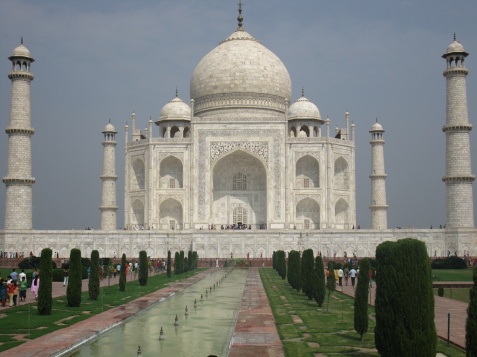 After a 15-hour train ride, we arrived in Agra in the height of the Dubali Festival. We were told by our hotel upon leaving Varanasi that not too many people sleep on this night, whether you want to or not, as fireworks and firecrackers go off all through the night and into the early morning. The nice thing about staying at the Hotel Sheela was that it was in a quiet area near the East Gate to the Taj Mahal and that it was set back from the road. So the noise of the Dubali celebrations were not so bad, affording us to get some sleep, contrary to what we had been told.
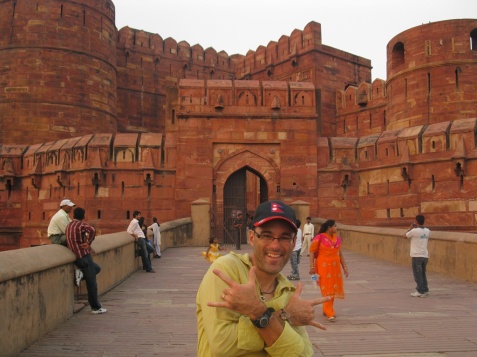 The principal reason for our stay in Agra, of course, was to see the iconic symbol of India, the Taj Mahal, plus the imposing Agra Fort, which is romantically connected to the whole story of the Taj. As much as one can’t come to Agra without laying eyes on the impressive and massive Agra Fort along the Yamuna River, which for us was as soon as we arrived into Agra by train as we crossed over the river in the early morning hours. As we arrived at the entrance gate to explore Agra Fort’s palaces, temples and courtyards, we were immediately taken back by its sheer size.
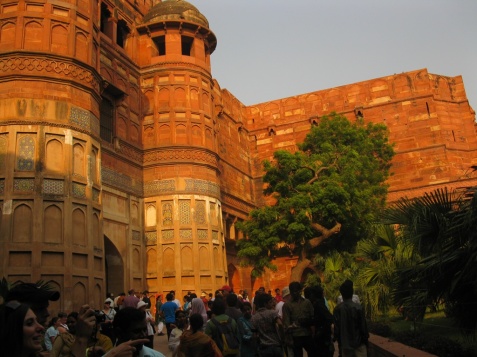 As we entered Agra Fort, we were dwarfed by its tall red sandstone walls that rose 20 meters high into the sky, as we stood in its shadows feeling somewhat like ants.
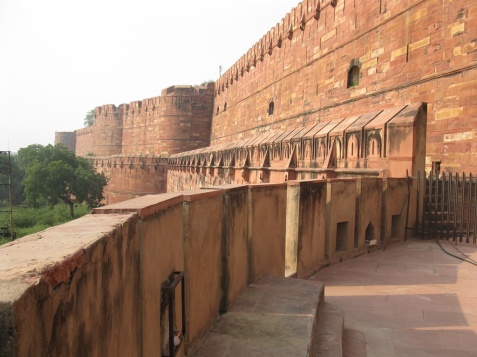 Apparently this outer wall goes on for 2.5 kms to fortify Agra Fort, in addition to the moat that surrounds it for an additional defence measure, and as if that was necessary…really!
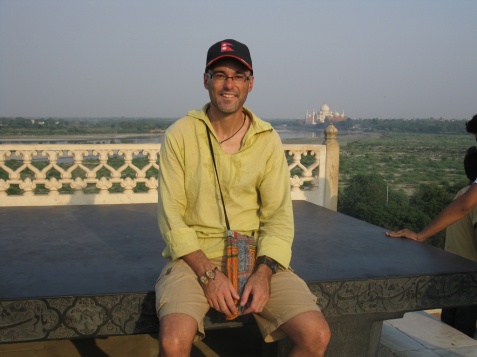 At one point as you go through one of the palaces and onto a small courtyard next to this imposing wall, one can gaze out into the distance through one of the many stone-cut windows to appreciate a splendid view of the great Taj Mahal, as many visitors were doing. Considering that construction of the various buildings in Agra Fort commenced in 1565, it is remarkably well preserved and is an impressive site to visit.
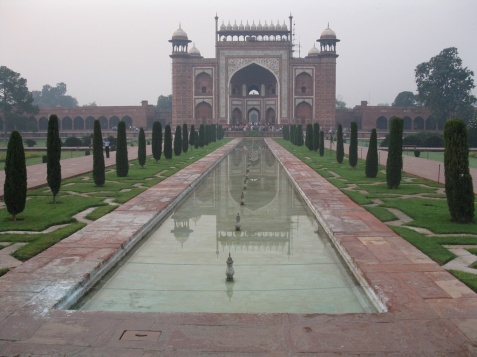 Of course the lure to Agra is without question, as much for us as for many people, whether they be tourist, Indians or Muslims, is quite essentially the great Taj Mahal. As we passed through the gateway and into its manicured grounds, one leaves the noise, dust and busy streets to be quickly enveloped into this tranquility and beauty of green gardens and trees, and of course the imposing monument as its most striking and captivating feature at the far end, the Taj Mahal.
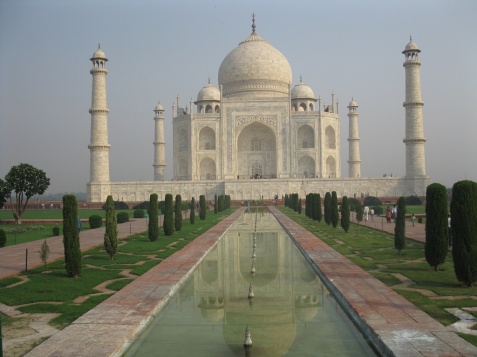 At first sight, chills came upon us, as its majestic beauty takes your breath away. There is literally no words to describe the Taj Mahal, you simply are taken up in an array of emotions and feelings. Many have tried to sum up its beauty “a teardrop on the face of eternity” according to Indian poet Rabindranath Tagore, “the embodiment of all things pure” according to British writer Rudyard Kipling. Immediately, it casts its spell on anyone who lays eyes on it, you are memorized and captivated by the Taj Mahal’s simplistic beauty and elegance.
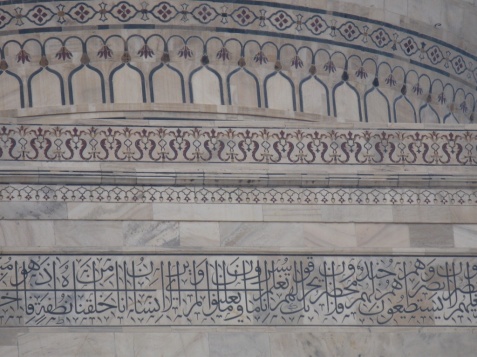 Perhaps this is one of its great features, in its pure and simplistic design, one can absorb its grandeur, compared to other temples and monuments that overwhelm you with their decor, statues, use of colors and varied stones and materials, symbols and intricate designs, enabling you to truly appreciate the magnificence that is before you. You feel as if you have fallen in a trance, as your eyes are constantly drawn to gaze at it, and why wouldn’t you. As you stand before it, you quickly understand why it is considered one to the greatest world wonders along with the likes of the Great Pyramids of Egypt and the Angkor Wat Temple of Cambodia.
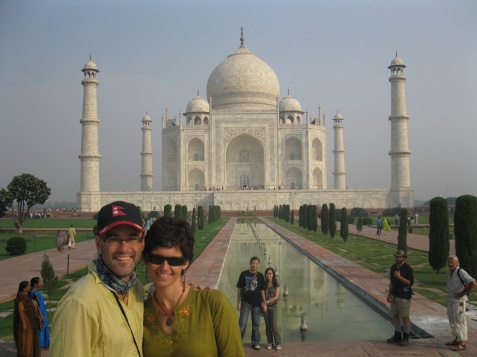 The Taj Mahal was built by Emperor Shah Jahan as a memorial to his second wife Mumtaz Mahal, who died giving birth to their 14th child in 1631 (no wonder!:>). The death of Mumtaz left the emperor so heartbroken that his hair is said to have turned grey overnight. Construction of the Taj Mahal began in the same year and wasn’t completed until 1653. Not long after it was finished, Shah Jahan was overthrown by this son Aurangzeb and imprisoned in Agra Fort where, for the rest of his days, he could only gaze out at his creation through a window. Following his death in 1966, Shah Jahan was buried here alongside Mumtaz.
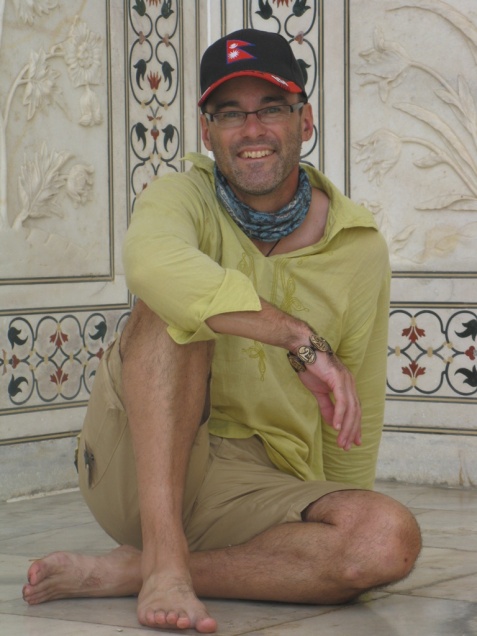 In total, some 20,000 people from India and Central Asia worked on the building. The spectacular mausoleum was designated a World Heritage site in 1983 and looks as immaculate today as when it was constructed. The only unfortunate impact that has occurred over time has been the recent atmospheric pollution which has begun to gradually discolour the white marble and erode the fine carvings and inlays.
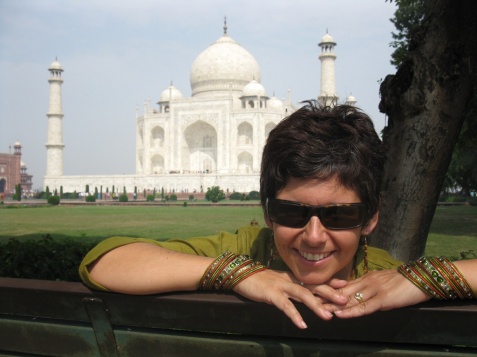 The Taj Mahal is all about symmetry, and one can appreciate this by observing the monument itself, as well as the surrounding grounds, in great detail. An interesting fact that we discovered was that the height and the width are the same, which is contrary to most buildings. It stands 1002 feet in height, while its bulbous central dome having a height of 213 feet. The four minarets stand 40 meters in height, and after three centuries they lean slightly outward, which may have been purposely part of their design in the event of an earthquake, so that they wouldn’t fall on the precious Taj Mahal. Standing on any side of the Taj Mahal, you basically can appreciate the same design which is repeated on all four sides, pure symmetry. Impressive vaulted arches embellished with pietra dura scrollwork and quotations from the Quran in a style of calligraphy. You can also appreciate beautiful carved flower patterns inlaid with thousands of semiprecious stones in the white marble.
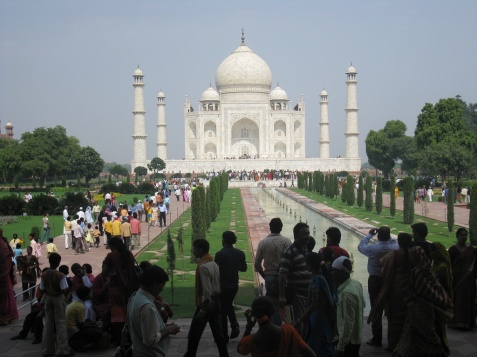 However, it’s from the front of the Taj Mahal and its manicured gardens that its beauty truly abounds and is embellished. It’s the ideal postcard picture, in every sense of imagery. Looking into the long narrow ponds of water, one can savour the reflection of the Taj Mahal which is simply magical as the sun rises to light it up in a golden color before the light of the day exposes the purity of the white marble. Interestingly enough, the white marble in which the Taj Mahal was constructed from came all the way from (Ragistan), by elephant express of course.
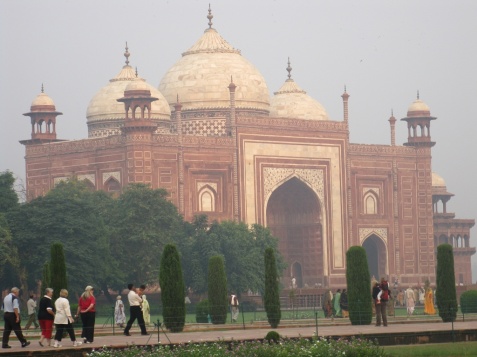 On both sides of the Taj Mahal is two rather large red sandstone buildings, one of which is a mausoleum while the other served travelling visitors. Later on, this building was used as an area to host gatherings as well as a guesthouse for important guests of the King. We have to say, it’s one big guesthouse!
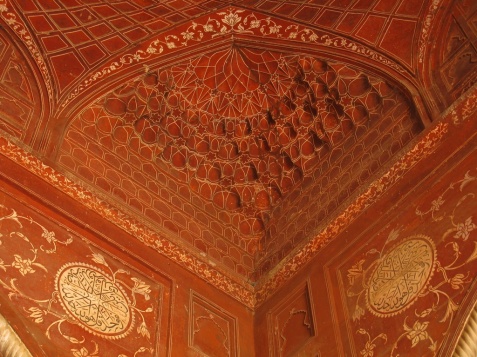 Apparently, the story goes that they build the mausoleum on the left hand side first, and then soon realized that the symmetry had been broken, so they built the second one on the right to rectify the situation and re-establish the perfect symmetry of this magical place.
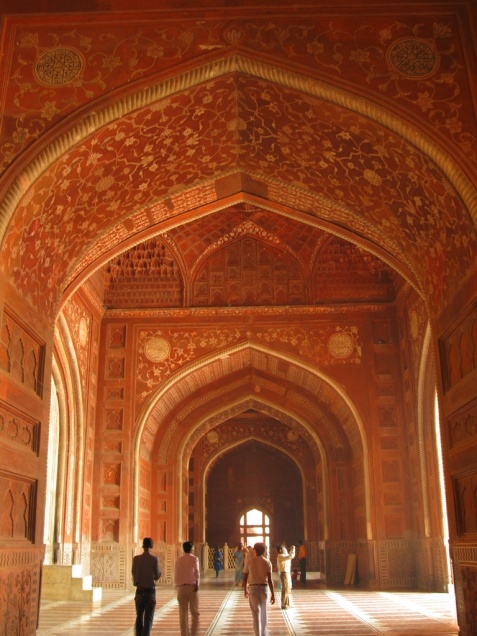 There is also another story that the King wanted to build another Taj across the river in black marble for himself, ying and yang if you will, but that never materialized obviously, but may have very well have been the reason he was imprisoned as the story goes.
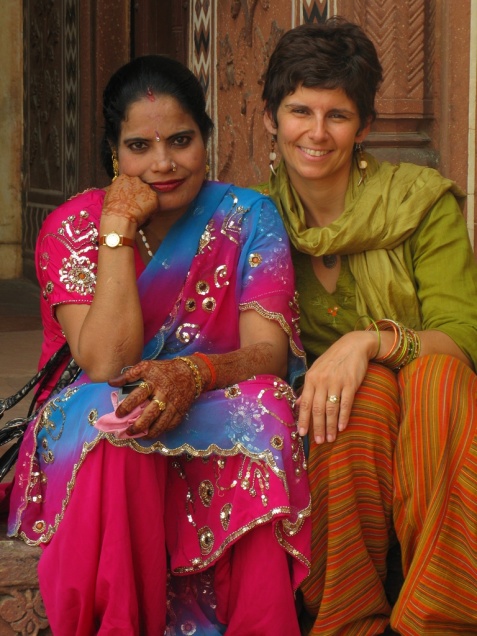 As we were leaving the mausoleum, we encountered an Indian couple who stopped and were trying to make some kind of interaction with us but did not speak English. We suggested a picture together and they seemed quite happy with that, as most are and are often asking if they can take our picture as though we are the first foreigners they’ve encountered.
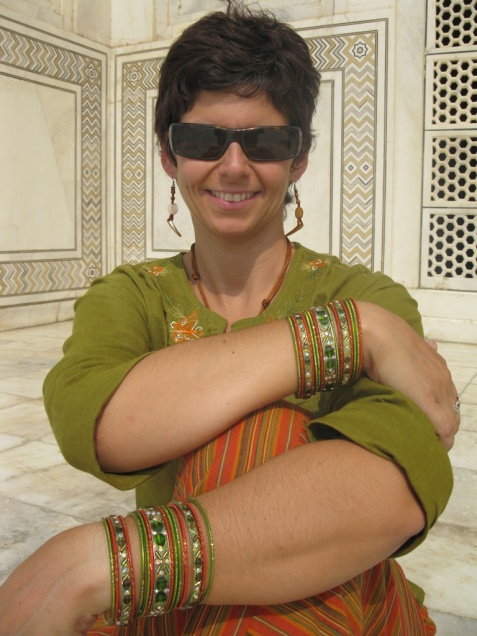 After spending five hours in company of the Taj Mahal, at the end we couldn’t seem to bring ourselves to leave. We would start to make our way towards the exit, but would quickly find ourselves either sitting on a bench or a ledge gazing at the Taj once again. Its seduction is simply relentless, but hey, what’s wrong with that, it’s not every day that you get the privilege to spend your morning in the company of the world’s most extravagant monument ever built for LOVE!
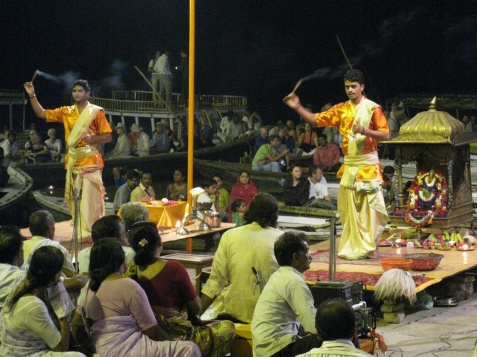 Our first night in Varanasi was highly fascinating, as around 7 p.m., we took in the elaborate “Ganga Aarti” ceremony with puja (giving of offerings, respect or prayer) to the rising and setting sun, fire and dance. This elaborate ritualistic ceremony was conducted by five Brahmans (monks or priest) on the edge of the Holy Ganges River at the Dasaswanath Ghat and lasted for a good hour.
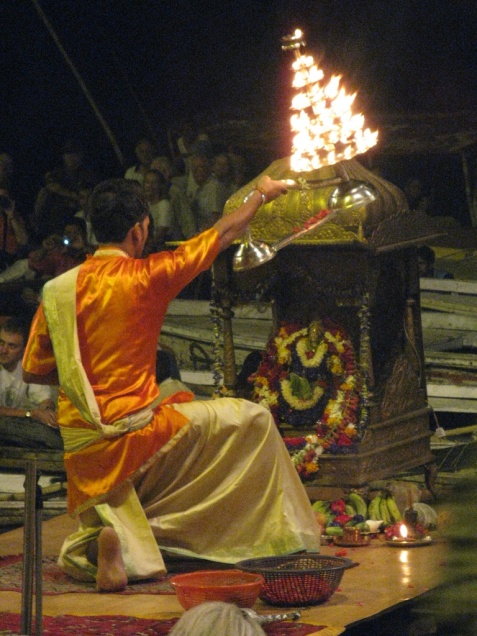 The Ganga Aarti ceremony consists of numerous rituals, from bell ringing, incense burning in a perfusion of smoke, flowers thrown in the air, over a small temple and into the Holy River, candles burning, and so on, all for the benefit of the Holy River Ganges.
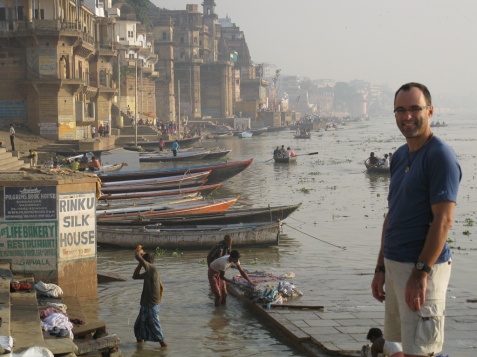
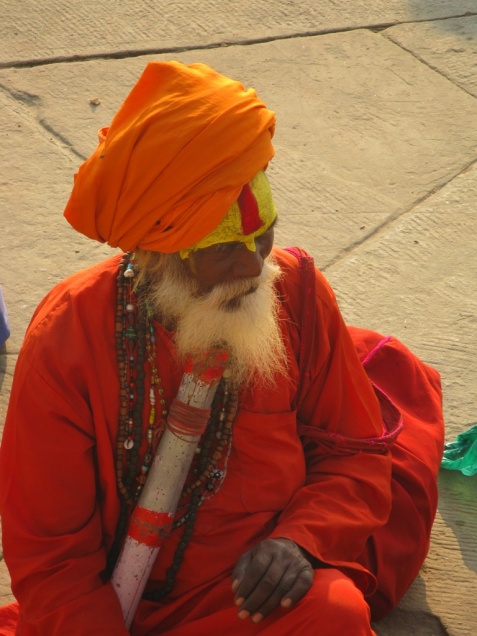 Another enjoyable and essential experience when in Varanasi, is to walk along the Ganges and along the many bathing Ghats that dot this most incredible scene along the river’s edge.
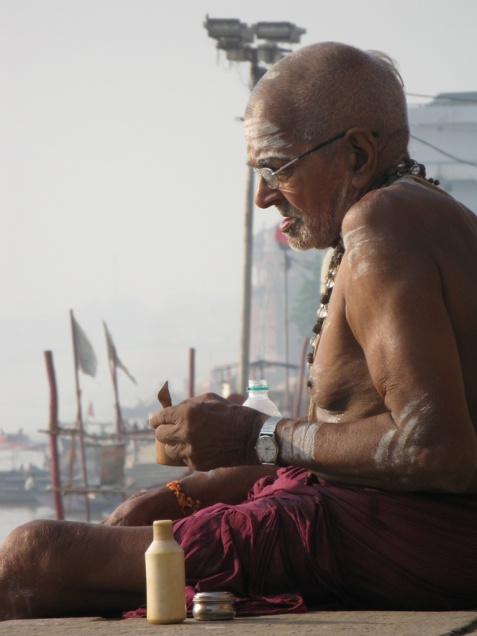
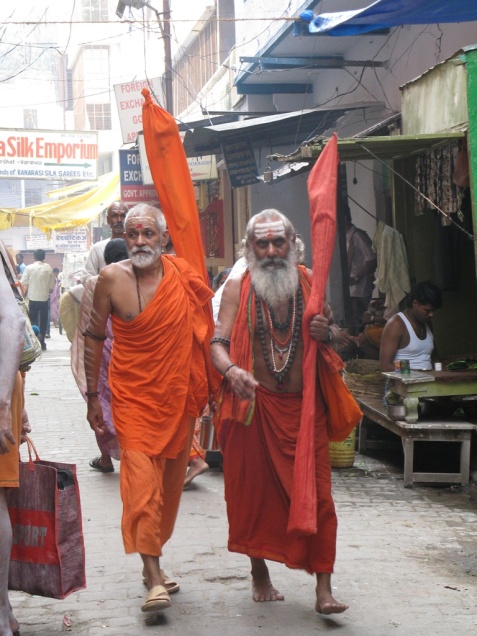
 One thing that is for certain when doing this walk, is that you never know what you’ll see or experience. Such as meeting many of the “sadhus” that stroll up and down the Ganges in their striking costumes, and I do mean costumes, as some of these are what you would call “tourist sadhus” who are dressed up for the benefit of tourist and to get some free and easy money, while others are the real thing, with spiritual intentions. Our guess would be that the one in the background of this photo meditating is the real thing and the one asking for money and wearing Lori Ann’s sunglasses was not! :>)
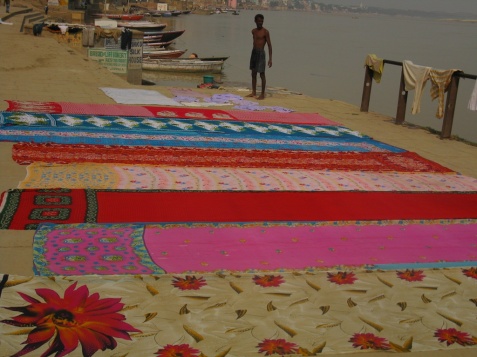
 Another daily scene is the washing of clothes in the holy Ganges river, we are not quite certain if it’s the fact that it’s a holy river or the intense beating of it on concrete that gets the clothes so clean, because we can’t comprehend washing clothes in water dirtier than the clothes themselves. Regardless, it makes for a very colourful scene as the sarees are laid out to dry on dirty concrete to create a rainbow of cloth along with the rest of the wash.
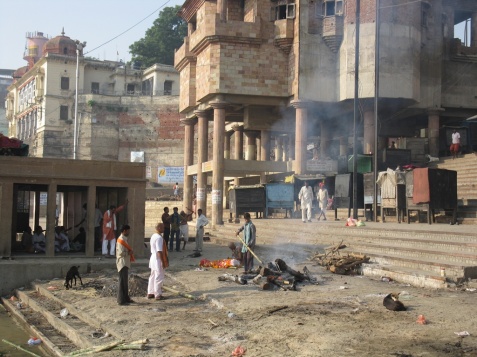 As we walked along the Ganges, we observed in silence our first cremation ceremony on this holiest of rivers. The river Ganges in Varanasi is a very auspicious place for any Indian to be cremated, as after the body is burned with approximately 300 kg of wood, preferably sandalwood if the family can afford it, the remains of the body are wrapped in a cloth and sent down the Holy River Ganges, back to the earth.
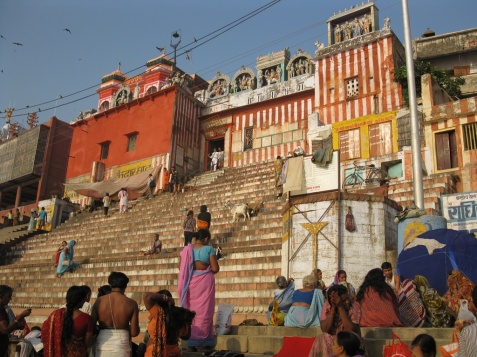 At the top of another of the bathing steps, a large Hindu temple stood as a fixture of the religious nature of the Ganges.
 Below was an ongoing number of people going in and out of the Ganges to bathe, while others prayed and meditated on the steps or prepared to go worship in the temple among the variouis Hindu Gods.
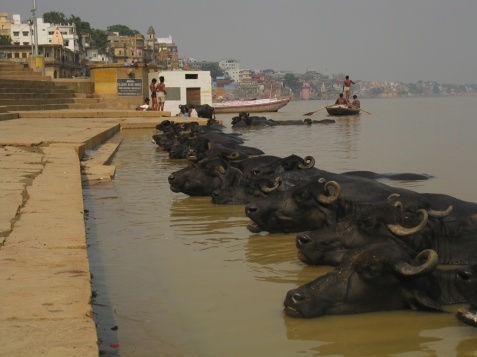 On another occasion, on a very hot day, which are very common here we should add, we noticed a very particular scene along the edge of the bathing steps to the Ganges, as we made our way to check it out, we discovered that it was water buffalos bathing themselves in the water, to escape the days heat no doubt. All lined up in a row, they looked like a bunch of kids taking swimming lessons from their swimming instructor at the city pool.
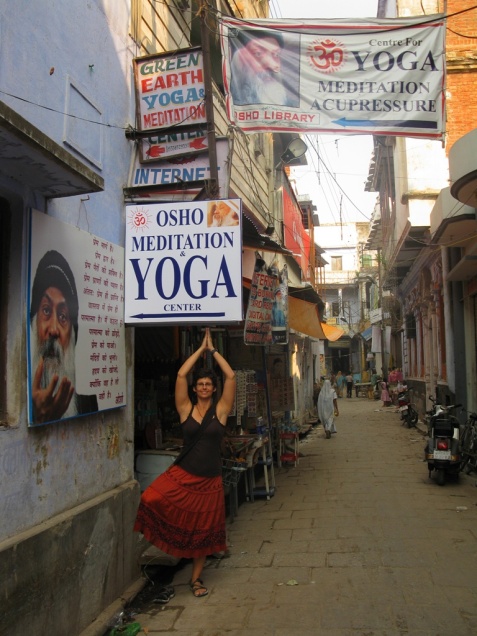 Leaving the restaurant we made our way down the back narrow allies of Varanasi, never really knowing where we were going but believing that we would eventually find our way as we were meant to in order to find an ATM of all things. The next thing we knew we were in a meditation centre doing a shaking and dancing meditation which was inspired by the teachings of OSHO. As we shook our bodies for about 20 minutes and then subsequently danced for another 20 minutes, when we came to doing the sitting meditation, we felt as if all the tension and stress within our bodies had melted away to allow us to meditate in a state of mind of complete peace and calmness. After having meditated for 20 minutes, we got into a sleeping pose in order to attain an even deeper state of rest and relaxation, so much so that Ricky fell asleep and snored (as per the account of Lori Ann Hitchcock).
 An hour and a half later, we were once again going down the back allies of Varanasi discovering and seeing the true India, and a way of life that we previously never thought of experiencing and seeing with our own two eyes.
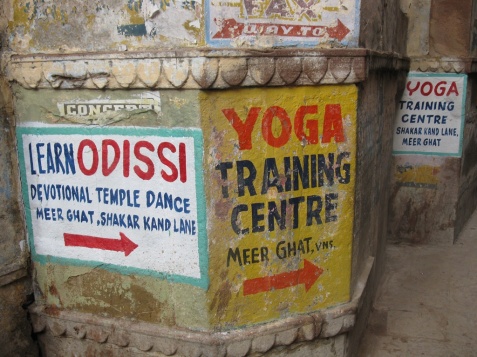 Every corner of every building on the back streets of Varanasi are plastered with directions to yoga centres, and other forms of healing practices.
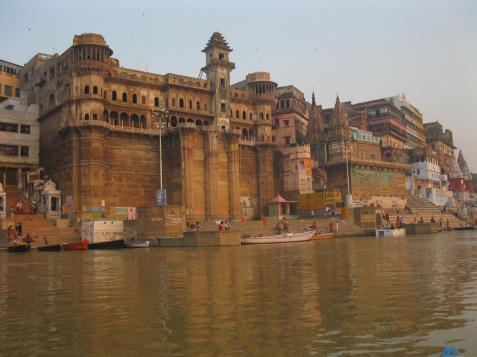 The next morning we woke up at 5 a.m. to go down for our boat ride down the Holy River Ganges, which is the most essential of experiences when in Varanasi. Already at this time, in the morning darkness, we could hear the Indian people chanting, bells a ringing and see people bathing in the Holy River. At this early time of the day, the air was cool, but within four to five hours, the day’s heat would be upon us reaching between 30-35 degrees, as Varanasi is known to be a very warm place.
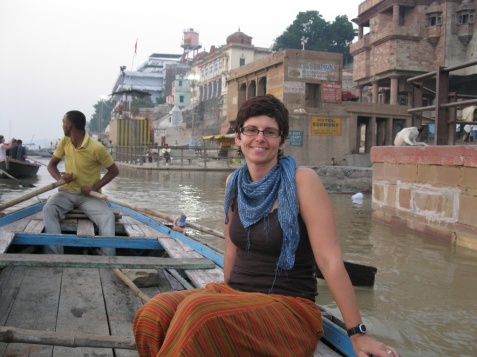 As we hopped into our boat, a version of a large dore, we set off up the Ganges, appreciating the views of this ancient holy city with its perfusion of bathing steps, ghats, and palaces that were once occupied by the emperors, oh what it would be like to go back in time to see this place. An interesting element of a day along the Ganges is the noticeable changes in light that brings a different effect on the scene before you.
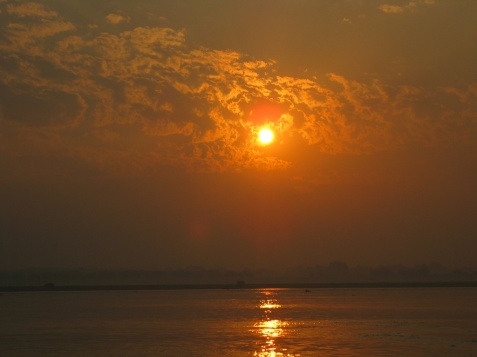 As you set off, the early morning darkness soon changes to a dim light, until the sun appears over the horizon on the other side of the Ganges to transfer this amazing scene in an array of colors. Going from an orange to an inspiring golden color, which is the most striking, the clear light of the day seems to quickly make its appearance, as one is completely drawn into this most amazing of spectacles. All of this of course happening in a morning haze which eventually seems to dissipate by mid-day.
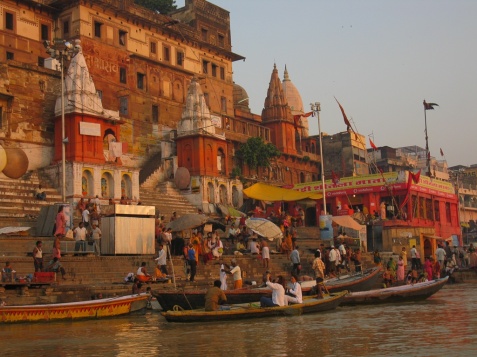 As we floated by one the main cremation ghats of Varanasi, we could see a body ready to be cremated already at this early hour. As we turned around to make our way back, we leisurely flowed down the Ganges to the Dasaswamedh Ghat, where there was an absorbant amount of people who had come down to bathe in the river. This is without question the most surreal river experience we have ever had the joy and privilege to experience, even more so than our Ghondola ride down the canals of the great city of Venice in Italy. It simply felt like a very special moment for us, or as they say, a very “auspicious” moment.
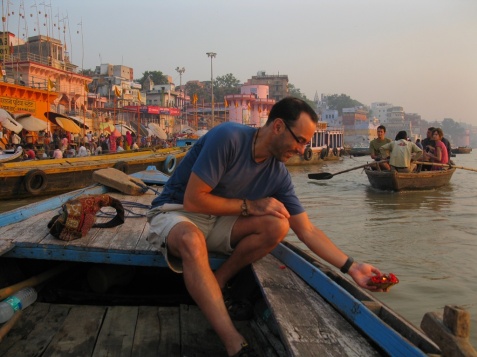 We also had to occasion to send off a lit candle down the Ganges…
 As we disembarked from our boat, we made our way to the Dasaswamedh Ghat to be amongst this most magical scene we had appreciated from our boat on the Ganges.
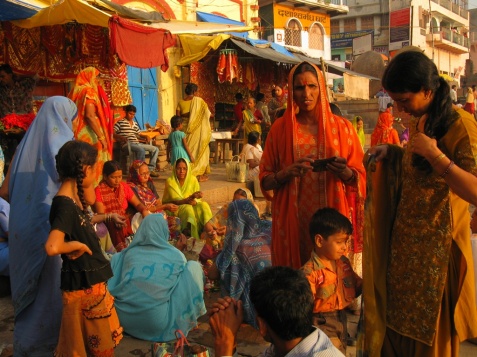
 As we walked around the Ghat and along the river, we could observe in silence and respect, groups of women all gathered in a circle performing a ritual prayer. The whole prayer was a very colourful display of Hinduism. There were also a large number of priest under these large straw umbrellas performing prayers at the request of people.
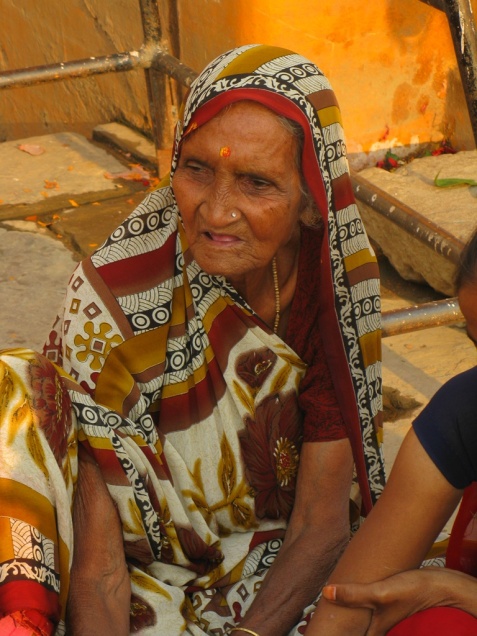
 Everywhere we looked was this most incredible morning experience, we could see the faces of India down on the bathing steps of the Holy River Ganges…these were the faces we had expected to see in this Holy City.
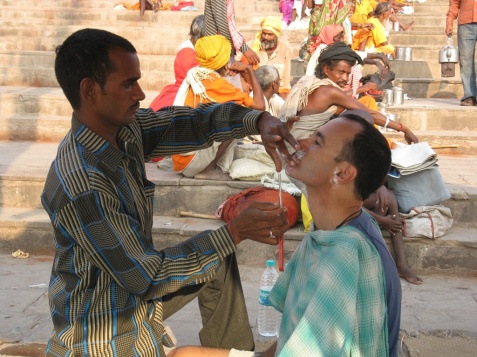 Afterwards, in the mists of all this, something quite unexpected happened, Ricky got a most needed shave in this most auspicious of places by an Indian barber, a very unique experience to say the least.
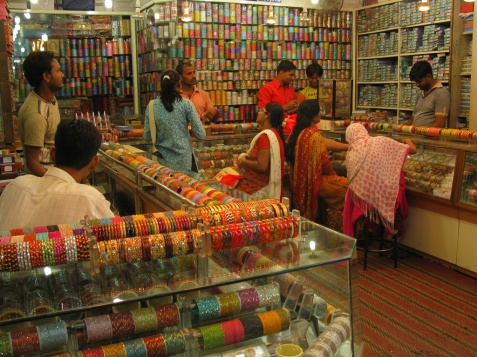 Walking down the side streets of Varanasi, one can’t miss the bangle shops, it’s like going to a jewellery store, but these shops only carry bangles, and in every colour of the rainbow. Every Indian women, from the infants to the elderly, wear bangles, and some in large numbers, too.
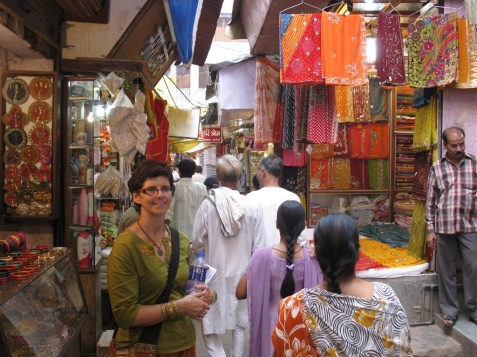 So Lori Ann decided to get her own bangles, and after 15 minutes, the shop keeper had her all decked out with an assortment of beautiful orange and green ones inlaid with some semi-precious stones to boot, another happy customer.
 Another thing that we discovered while in India is that they truly enjoy shopping, just as people in North America or anywhere else for that matter, do. The only difference being that 80% of the shops are either selling sarees, bangles, jewellery or clothes. It’s a shopping chaos with people filling the streets and more signs and banners that you can wave a stick at, it’s simply overwhelming to the senses, with the perfusion of colour, chatter of the people, horns honking and smells of street vendor stalls, etc.
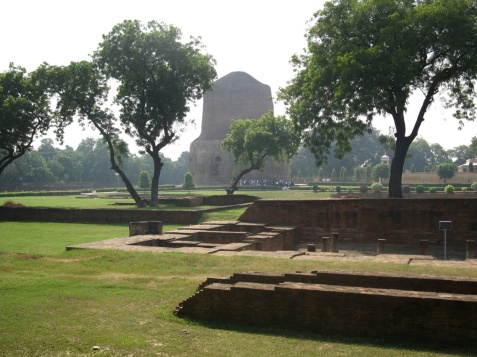 The next morning we ventured to Sarnath, which was the place where Buddha gave his first lecture and teachings to his followers. Many people make their way to Sarnath as part of a pilgrimage, coming from many countries throughout Asia. On site are the ruins of an ancient monastery as well as a huge stupa that marks the spot Buddha gave his first lecture.
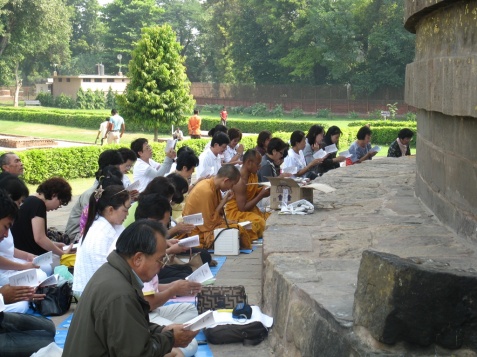 Many groups surrounded this stupa singing chants together. There are many countries that have established monasteries in Sarnath. Apparently, there are nearly 1500 monks that actively reside in these monasteries at any given time. This is also the home of Deer Park, a great place for meditation and reflection, but unfortunately it was closed on this day, which was somewhat disappointing.


 During the late evening, we enjoyed a lovely meal at the roof top restaurant of our guesthouse and took in the sights, sounds, and smells of Baktagpur during festival time. At different times during the day, we could see different groups of men playing an array of instruments, including drums, symbols and flutes, all part of the Nepalese traditions during this very festive time.


 Our trekking guide from Mountain Leaders, Gokul, who we will post on later, mentioned to us that his cousin, Bishnu, was studying his masters in business (major in HR) and planning to go to North America to study his PhD. We had the pleasure of meeting Bishnu when we arrived back in Kathmandu to answer his questions about Canada. He is a very personable and bright young man who is obviously destined for great things and we are glad to have met him and hope to continue to keep in touch.


